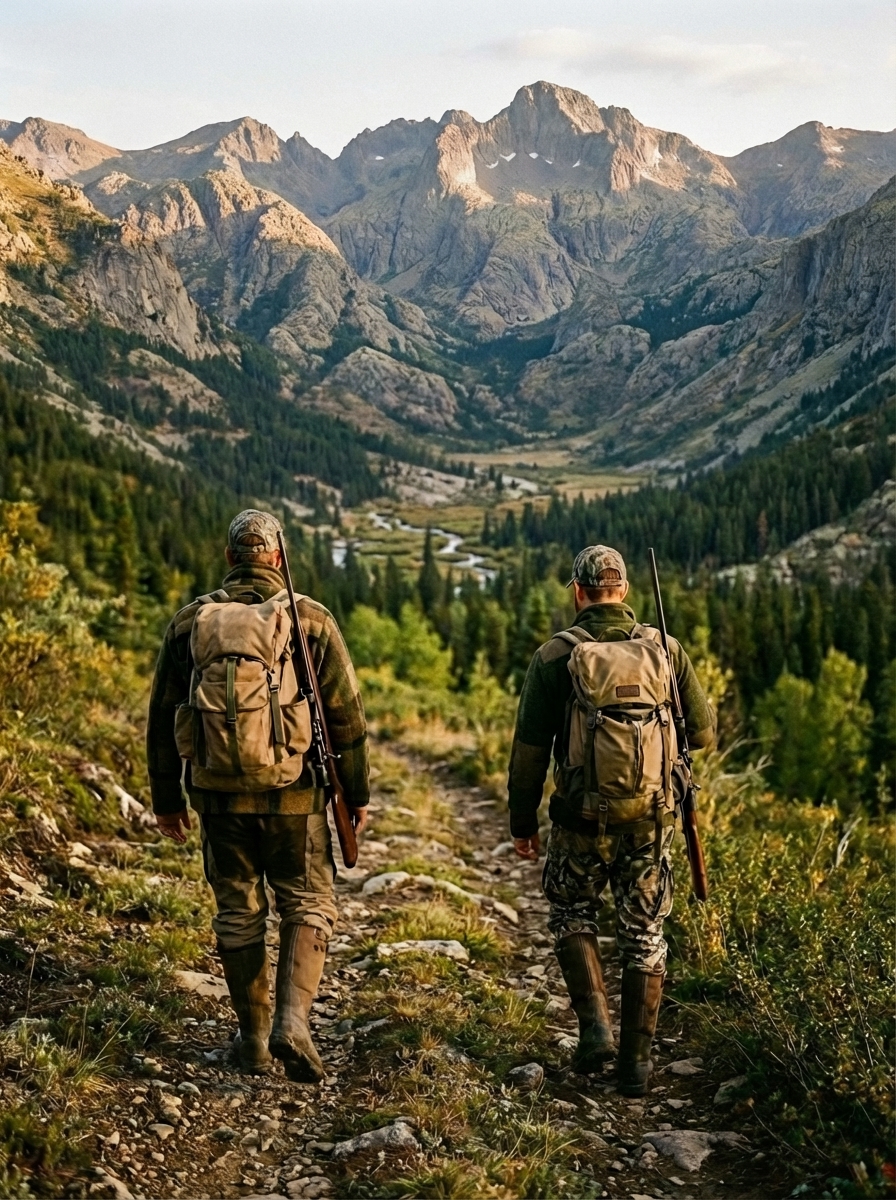
Big game hunting is one of the most exciting and demanding hunting activities that exist. It requires a deep knowledge of the terrain, mastery of the weapon, patience, and absolute respect for wildlife and the environment. In Spain and much of Europe, this practice is part of a deep-rooted tradition that combines sport, sustainable management, and rural culture.
In this article, we explain the main big game hunting techniques that every hunter should know, their particularities, advantages, and the scenarios where they work best. Whether you are a novice hunter or have spent years in the mountains, this guide will help you choose the most suitable modality for each day.
What is big game hunting?
Big game hunting refers to hunting activities directed at large species such as red deer, wild boar, roe deer, fallow deer, mouflon, chamois, or mountain goat. Unlike small game hunting, which pursues birds and small mammals, big game hunting requires superior physical and technical preparation, as well as higher caliber weapons and detailed knowledge of the behavior of each species.
The techniques used vary according to the type of animal, the terrain, the time of year, and the number of hunters participating in the session.
Main big game hunting techniques
1. The Montería
The montería is, without a doubt, the most representative modality of big game hunting in Spain. It is a collective hunt in which a group of hunters, called escopeteros or puestos (stands), are placed in strategic positions within a patch of scrubland, while a rehala (pack of hounds) accompanied by podenqueros (hound keepers) flushes out and pushes the animals toward the shooting lines.
Main characteristics:
It is usually practiced between October and February.
It allows for hunting several species in a single day: wild boar, red deer, fallow deer, or mouflon.
It requires coordination, discipline, and absolute respect for safety rules.
It is ideal for large estates and preserves in central and southern Spain.
The montería combines tradition, spectacle, and emotion, being one of the most sought-after experiences for big game hunting enthusiasts.
2. The Gancho
The gancho is a variant of the montería, but with a smaller number of hunters and dog packs, and on a smaller area of land. It is usually organized during the week or when it is not possible to organize a full montería.
Advantages of the gancho:
Lower cost per hunter.
Greater agility in organization.
Good option for managing specific populations of wild boar.
It is a very popular modality in areas with a high presence of boars, where frequent population control is required.
3. The Batida (Drive)
The batida is similar to the gancho, although it is generally carried out with an even smaller group and in specific areas, often motivated by agricultural damage or health issues. It is used mainly for wild boar control on agricultural estates, vineyards, or peri-urban areas.
This technique is common in northern Spain, where the terrain and vegetation favor this type of more intimate and dynamic hunt.
4. Stalking (Rececho)
Stalking is the most selective and silent big game hunting modality. It consists of locating the animal through observation, approaching it by taking advantage of the wind, terrain, and vegetation, and taking it down with a precise shot at medium or long distance.
Most commonly stalked species:
Red deer (especially during the rut or "berrea" in September).
Roe deer (in spring and summer).
Chamois (in high mountains).
Spanish ibex (in rocky areas).
Southeastern ibex in the Betic mountain ranges.
Stalking requires excellent physical fitness, ballistic knowledge, quality optics, and, above all, patience. It is the preferred modality for hunters looking for a selective trophy and a more solitary and reflective experience.
5. Waiting or Stand Hunting (Espera or Aguardo)
In this technique, the hunter stations themselves in a strategic place—a high point, a feeding area, a watering hole, or a regular animal path—and waits for the animals to arrive. It is usually done at dawn, dusk, or during full moon nights (when legislation permits).
It is especially effective for:
Wild boar in crop areas.
Red deer at watering holes during the summer.
Damage control on agricultural estates.
Waiting requires patience, absolute stealth, and a good knowledge of the animal's habits.
6. Walking-up Hunting (Caza en mano or al salto)
Although it is more common in small game hunting, in some areas a variant is practiced for wild boar, in which small groups of hunters move through the brush with dogs, flushing out animals at short distances. It is a very active, physically demanding modality typical of the rugged terrain of the northern peninsula.
7. High Stand Hunting in Boar Monterías
A specialized technique in which the hunter remains in an elevated position or safe high stand, usually on a platform, waiting for the dog pack to push the boars. It combines elements of the traditional montería with waiting and is widely used in intensive preserves.
Recommended equipment for big game hunting
Regardless of the chosen technique, having the right equipment makes the difference between a successful day and a frustrating one:
Bolt-action rifle with an appropriate caliber (.270, .308, 7mm Rem Mag, .300 Win Mag, 9.3x62, etc.).
Quality optical sight with magnification suitable for the modality (1-6x for montería, 3-12x or higher for stalking).
Binoculars and, for stalking, a laser rangefinder.
Technical clothing suitable for the climate and terrain, in camouflage or earth tones.
Mountain boots that are waterproof and have good soles.
Lightweight backpack with supplies, a knife, and a basic first aid kit.
Legal and ethical aspects
Big game hunting in Spain is strictly regulated by regional and national legislation. Before heading to the mountains, it is essential to:
Have a valid hunting license in the corresponding autonomous community.
Have civil liability insurance for the hunter.
Have the firearms permit and registration in order.
Respect the open seasons for each species.
Comply with the technical hunting plans of the preserve.
Always apply the principles of ethical and selective hunting.
Respect for the animal, nature, and fellow hunters is the foundation of any well-understood hunting day. A responsible hunter actively contributes to the conservation of ecosystems and the balance of wildlife populations.
Conclusion
Big game hunting techniques are as varied as they are exciting. From the collective spectacle of the montería to the meditative solitude of stalking, each modality has its charm and requires specific skills. Choosing the right technique depends on the species, the terrain, the time of year, and, above all, the hunter's personal preferences.
Whatever modality you choose, remember that hunting is much more than taking an animal: it is respect for nature, sustainable management, and responsible enjoyment of a millenary tradition. Good luck and better aim on your next hunt!